


Governance encompasses a set of features that let you implement your preferred validation, review, and compliance processes. By integrating governance capabilities within the model development process, Domino shortens the time to value for agents, apps, models and other assets that need to be governed. Domino’s governance features also let you standardize and automate many aspects of governance, such as evidence generation and common checks.
A bundle is a container that holds materials or work items (e.g., models, files) you want to govern as a group, and allow the application of policies to that material. To govern anything, it must be in a Bundle.
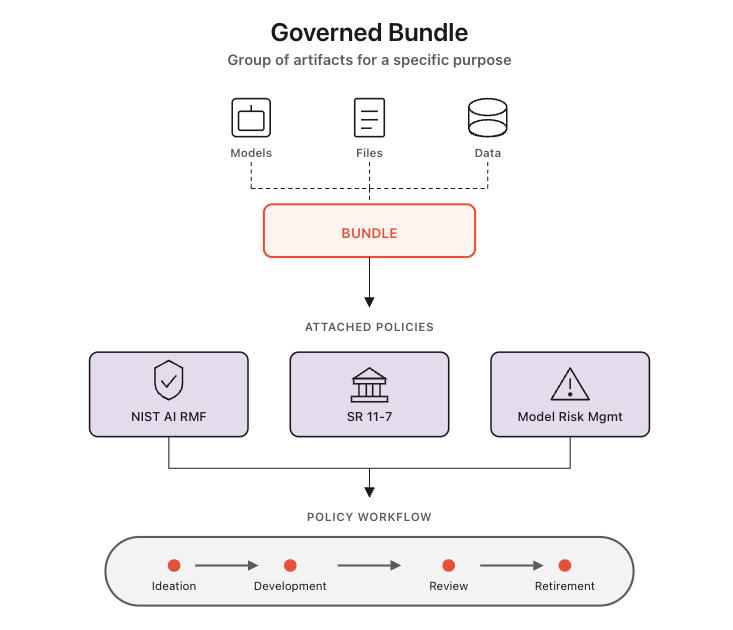
Policies define the governance lifecycle that a bundle must go through, and what evidence and approvals are required for it to be compliant. You can apply multiple policies to each bundle; and you can reuse the same policy across many bundles. You define your policies, they are fully customizable. In practice, you will create policies that reflect facets of your compliance process (e.g., “Data Privacy Policy” or “Infosec Policy”), as well as policies that reflect industry frameworks (e.g., “NIST AI RMF” or “SR 11-7”).
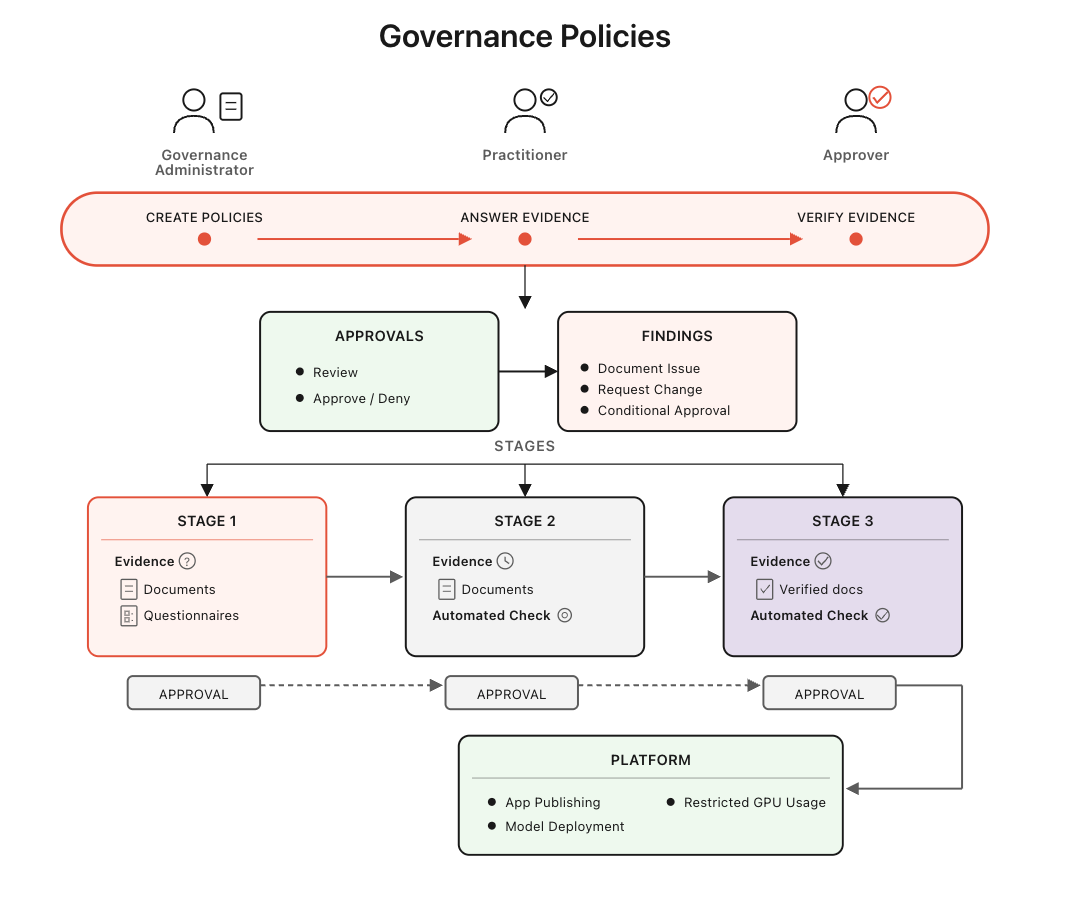
Anatomy of a Policy
-
Stages represent the phases you expect work to go through (e.g., Use Case Definition, Data Selection, Deployment, Ongoing Monitoring).
-
Stages contain evidence. Your policy defines what evidence is required in each stage. Evidence can be collected as a variety of input types, including static responses, attachments, or calculated/computed results.
-
-
Approvals specify who must sign off on the provided evidence before a stage will be considered completed. It can also control transitions between stages. If a reviewer identifies an issue, they can create a finding to document and track it.
-
Gates let you enforce that certain actions (e.g., deploying a model or an App) cannot be performed until certain Approvals are completed.
Findings are issues that are found during the course of reviewing evidence. Findings apply to a specific bundle, and will typically be related to a specific piece of evidence that one of the bundle’s policies requires.
-
Work with bundles: connect assets to policies and start the governance workflow
-
Define policies: create and configure policies (for Governance administrators)
-
Roles and security: understand permissions and role assignment for Governance
-
Audit Trail: review a log of user and system actions across the platform